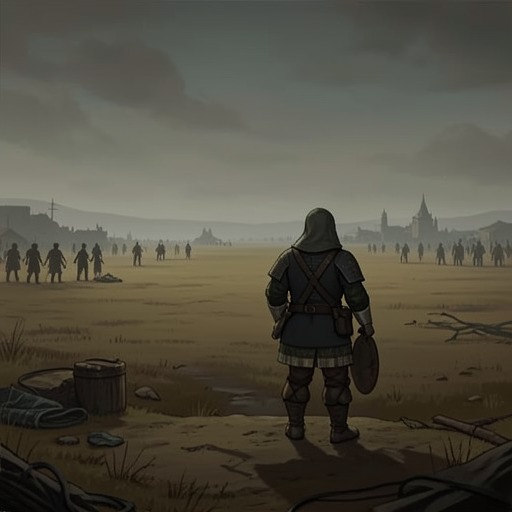
“We’re still aliens to each other”
The Swarm“We’re still aliens to each other” is Ijitsineq Akesuk’s warning that proximity does not amount to understanding. Spoken to Leon Anawak during a conversation about how to respond to the Yrr, the expression joins two kinds of estrangement: the cultural distance separating people who share a world, and the gulf between humanity and nonhuman life. Its point is not that these forms of difference are identical, but that they cannot be overcome by assuming that one side already knows what the other is.
The Meaning in Context
Ijitsineq Akesuk offers the phrase after Leon asks what can be done about the beings responsible for the crisis. He has just described a spiritual interpretation in which the beings are connected to the creatures of the Earth and to Sedna, the spirit of the sea. When Leon objects that they are not people, Ijitsineq shifts the question away from whether the Yrr qualify as human. They belong to the same world, he says in effect, as surely as hands and feet belong to a body. The relevant task is to make contact and understand, not to establish which species is more intelligent or to seek mastery over the others.
The expression therefore works as a correction to an easy division between familiar and alien. Humans may regard the Yrr as radically other, but human communities also remain strangers to one another. The phrase makes recognition a beginning rather than a claim of full comprehension: contact may heal divisions, but it does not make difference disappear.
Cultural Memory and Estrangement
The conversation’s force is grounded in Ijitsineq’s account of Inuit history. The Indian Act of 1885 broke the chain of oral tradition, while policies of relocation and assimilation severed people from homeland and disrupted the transmission of knowledge. He describes Inuit communities’ efforts to recover lives and memories after that rupture, while acknowledging that reparations could not restore what had been lost. In this context, alienation is not simply a failure of personal sympathy; it has been produced and deepened by political decisions that displaced people and weakened cultural continuity.
Ijitsineq also describes the more recent history of Inuit relocation: people were moved north from their traditional territory under the language of “relocation,” despite the damage to their hunting grounds and the hardship of the new settlements. He recalls being displaced himself, as were Leon’s parents. The history gives the phrase a specific human weight. A community can be present within a country and still be treated as foreign to the authorities that govern it, or separated from its own inherited knowledge.
From “Everything Is One” to Contact
An earlier teaching in Leon’s search offers a close parallel. Frank explains that “Everything is one” means a change to a river affects humans, animals, and the sea; change in one part of the world affects the rest. He calls this ecology, but the teaching also insists on a relationship that cannot be reduced to human control. Ijitsineq’s later appeal to see the Yrr as part of the human world carries a similar relational logic into the crisis: the boundary between species does not cancel interdependence.
The phrase does not promise that communication will be easy or that humans can translate another kind of mind into their own terms. Instead, it identifies the presumption of familiarity as an obstacle. Leon’s scientific framing and Ijitsineq’s spiritual account are distinct, but the elder’s counsel asks him to approach the unknown without making superiority the measure of understanding.
The Expression’s Ethical Claim
Ijitsineq rejects victory as a meaningful resolution between humans and the Yrr: struggles for mastery, he argues, end in death. His alternative is to learn to understand rather than fight. The expression condenses that counsel into a reciprocal condition: humans cannot expect to bridge the distance to another intelligence while ignoring the distances and historical injuries among human beings themselves.
In this way, “We’re still aliens to each other” is both a statement of limitation and a demand. It concedes that difference remains, while refusing to treat difference as a justification for domination. The expression links cultural memory, ecological interdependence, and the possibility of contact, making humility—not conquest—the starting point for living with what humans do not yet understand.